

How Do Dog DNA Tests Work?
You probably know that DNA testing, for animals or for humans, involves sending in a saliva or blood sample and waiting for the results. But what happens to your dog’s sample after it gets to the Embark lab? Let’s break down the science behind how dog DNA tests work.
How do dog DNA tests work?
Your dog’s Embark journey starts by swabbing their cheek for a saliva sample. After ordering an Embark dog DNA test, you’ll receive a kit in the mail containing a cotton swab, a collection tube, and a return envelope.
Remove the tube from the packaging. Holding the tube end, swab your dog for 30–60 seconds. Check out our tips about how to swab your dog to get the best results. When you finish swabbing, you can unscrew the cap, place the swab in the tube, close the tube, and shake it to mix.
Remember to activate your kit online before you mail the swab back to us! Then place the swab in the prepaid envelope and drop it in the mail. We’ll take care of the rest.
A quick introduction to how DNA works
You know that Embark dog DNA tests work by analyzing your dog’s unique genetic code. But what’s in that DNA?
All DNA is made up of four letters: A, T, C, and G. DNA is double stranded, which means it has two strands of letters that bind to each other. These letters are like matching puzzle pieces. A always matches with T, and C always matches with G. This is important because the matching rules allow us to “read” your dog’s DNA.
If all the DNA inside just one of your dog’s cells was stretched out, it would be over six feet long. And if all the DNA in all of your dog’s cells was laid out end to end, it would reach into outer space—going to the sun and back to Earth several times.
So how does all that DNA fit inside one microscopic cell? The answer is chromosomes. DNA wraps around proteins to form chromosomes: X-shaped structures that live inside every cell. Think of it like a very long string, wrapped tightly into a ball so it can fit in your pocket.
When we first look at your dog’s DNA, it looks like a long string of A, T, C, and G. By itself, it doesn’t mean much. That brings us to how dog DNA tests work by translating those letters into insights about your dog’s traits, breed, and health.
The science behind how dog DNA tests work
A big part of how dog DNA tests work comes down to what happens after we receive your dog’s sample.
The science of how DNA genotyping works is part DNA experiment, part computer. First, we take the swab you sent us and separate the DNA from the other parts of your dog’s cells. Next, we use a process called amplification to make many copies of that DNA. Then we chop up the DNA into lots of smaller pieces, called “fragments.”
Next, we wash those fragments of DNA over our research-grade canine microarray. A microarray is a silica slide, similar to a microscope slide with many tiny wells. These wells are coated with probes, which are small sequences of DNA that target specific places in the dog genome. (This is where A/T matching and C/G matching comes in.)
We wait for your dog’s DNA to bind to the complementary DNA probes on the microarray. After giving it some time to bind, we add labels with fluorescent colors (red and green). These colors indicate which alleles, or genetic variants, your dog might have for each trait. When your dog has a DNA match, that spot on the microarray lights up red, green, or yellow. The color depends on which variants your dog has for any given trait.
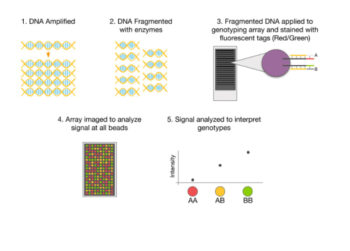
At every marker, we expect the fluorescent lights to be red, green, or yellow. If we zoom in to a specific marker on the microarray, it looks like this:
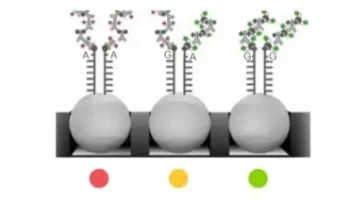
For example, let’s say this spot in the genome codes for brown or black pigment. Dogs with a bb result produce brown pigment in their hair and skin. Brown pigment is a recessive trait, meaning that a dog has to inherit two copies of the b allele (one from each parent) in order to show the trait. Dogs with at least one copy of the B allele (either BB or Bb) will produce black pigment.
A green light would mean that your dog’s genotype for this trait is BB, meaning they produce black pigment. A red light would mean that your dog’s genotype is bb, meaning that they have two copies of the recessive trait. And if your dog had one copy of B and one copy of b, the light would be yellow—a mix of red and green.
Because we test thousands of genetic markers, the entire microarray lights up with different colors.